
Tunic - Late Review
Green shirt, sword, shield... This fox looks awfully familiar...

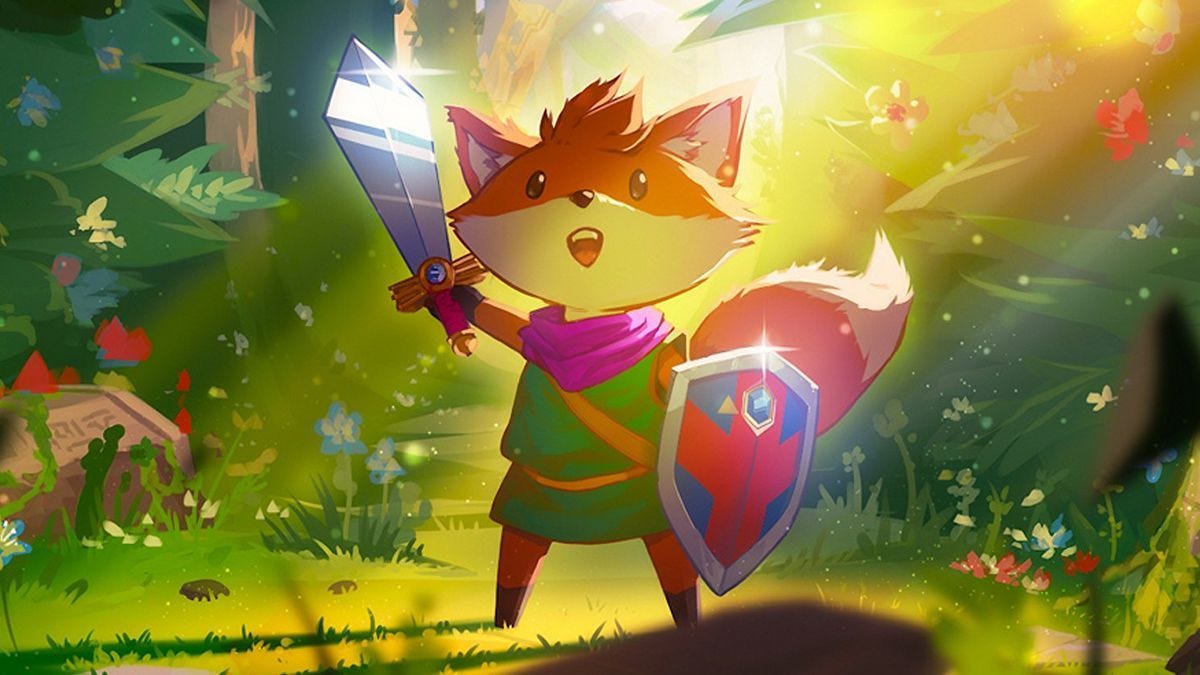
A young fox awakens on a beach, wondering where they are. Heading inland, they come to a signpost - it's written in an unrecognisable language. You open a nearby chest and claim its contents; the description is unreadable to you. The world may have a few simple antagonistic creatures, yet overall there is a peacefulness to your surroundings, giving you an urge to explore, even though you don't understand where to go or why. You eventually find a large golden door, perhaps to a temple or shrine, transporting you to a different realm, perhaps spiritual? You finally meet another soul, almost literally - an older fox, female, trapped it seems, wanting to escape. When you awaken you suddenly feel a sense of purpose... though you cannot explain how you know this. Finally, after some more exploration of the land, you come across a very important item - a page from a book. It still has text that you do not understand, but this finally has some words you recognise, plus pictures that provide some meaning. It's not a lot to go on, though now the little fox feels there is a direction. Determined, onwards they go, off on an adventure.
An Unexpected Journey
Tunic was the game selected by the Good Game Lobby as the choice for their game-of-the-month club in June 2026. For those not familiar, Good Game Lobby (GGL) is a fun group of people based all over the world who just love talking about video games. Once a month, we choose a game to play for the duration of said month, and then get to talk about it at the end - very similar to a book club. As this was my first time joining in with the conversation at the end, it was really exciting to talk about my thoughts on the game with people who equally share the same passion. Tunic gave me a lot (and the others in GGL) to think about, so I thought why not write them down? Perhaps my other reader might be interested too.
Tunic is a game released in 2022 on all the various platforms. It bears more than a passing resemblance to a certain legendary game featuring a Hylian hero who also sports a sword and shield. The perspective is even reminiscent of a Zelda or adventure game of the 16-bit era, adopting a mostly isometric viewpoint. The difference though is that this is rendered in 3D and adopts a beautiful art style. Everything reminds me of a model or diorama; trees and bushes are recognisable, yet angular and abstract. The sunlight will filter through cracks in ancient ruins to give light and shade, while the music that accompanies you feels relaxing, soothing. By first impressions, it looks amazing, with wonderful little touches to the environment or characters, such as your protagonist occasionally looking around as they move, as if their interest is captured by their surroundings just like you.
There have been many games in this adventure genre though, what makes Tunic stand out from the crowd? A number of things, actually.
Firstly, there is the fact that you don't understand what to do - intentionally. There are no characters in the overworld to talk to, and signs, messages and prompts are usually met with text in an unusual alphabet that cannot be deciphered. No-one is going to handhold you in this game, so it is your job to discover for yourself not just what to do but how the game works as well. In this sense, the game feels quite freeing, allowing you to wander and piece together your adventure yourself. As would be typical in the classic Zelda formula, you can't just go anywhere you want immediately - this isn't a sandbox. The path is actually very well laid out for you to progress, it just isn't immediately obvious. Once you do see where to go next though, the great lightbulb in your head flickers to life and understanding dawns on you, in the best way possible.
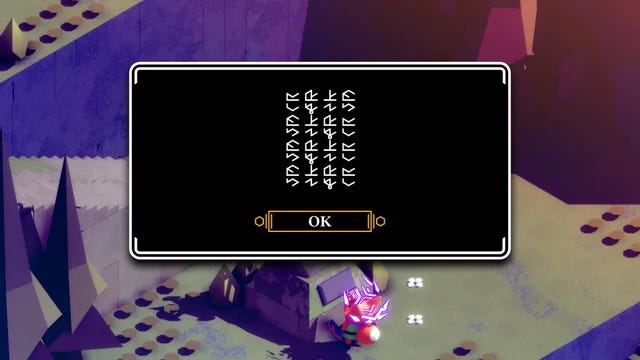
While you cannot read or be told what to do, you are not left completely helpless. Throughout the world you come across mysterious pages that have been torn from a book. This is Tunic's most unique aspect of the game, since these pages are for the game manual. What's that, young person? You don't know what a game manual is? Sigh... Well, back in ye olde days, where we counted console power in bits, games tended not to have prompts or tutorials to teach you how to play - the technical and design constraints usually did not allow this, unless you had designed an exceptionally well laid out game (looking at you, Super Mario Bros. World 1-1) Instead, a small booklet, the game manual, came along with your packaged game, explaining the fundamentals of the game (controls, saving or using passwords), and maybe, if the developer was having fun, some backstory, lore, and additional context. This is what Tunic aims to replicate, yet also integrate it directly into the gameplay.
As you discover the pages throughout your adventure, the cute hand-drawn and painted art style of the contents explain (without really using words) how to play, the key mechanics, the backstory and context of your adventure, and - best of all - explaining some of the secrets of the game. Just so long as you can understand it; like I said, Tunic has invented a unique language of glyphs that look nothing like what you can normally read, so you have to use some lateral thinking and observe the pictures carefully to divine some enlightenment. Some nice touches include some scribbled notes and known words here and there to act as clues, as if someone else had attempted to play the game and left some pointers for the next player. This act of discovery was one of my favourite parts of the game, as it meant I needed to use my brain to puzzle through even the basic building blocks of the game. Yet when I did feel like I had understood what the manual was telling me, and then seeing my experimentation work, it felt like I was the cleverest person alive.
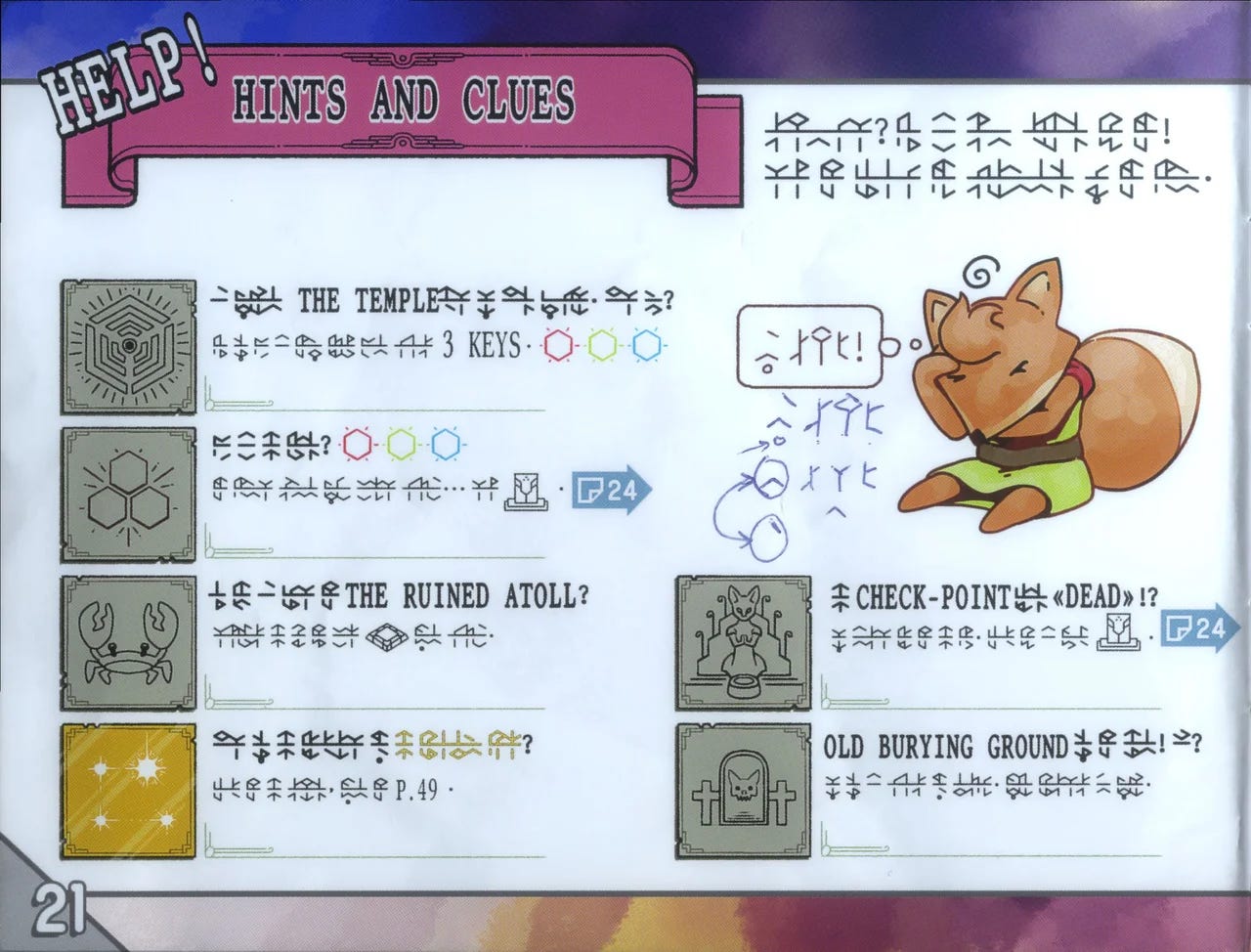
To make it slightly trickier, you don't recover the manual pages in order. There are gaps between your discoveries - early pages may explain combat and how to effectively fight enemies, some include maps though not fully complete, and some explain the story and background context but with key points missing. You feel like you're progressing, though you also feel like you don't have the full picture yet; the land is not the only thing you are discovering on your adventure. We'll come back to this point later.
So far this sounds like a nice, pleasant, whimsical quest. It looks and sounds cute, plus you're an adorable little fox. Well, as you'll discover in other parts of this game, looks can be deceiving.
You Died
When the GGL gang got together and talked about their experiences and thoughts on this game, one point seemed unanimous. This game is hard!
On first glance, this looks like a Zelda-clone, yet it also shares similarities with another game genre; the Souls-like. This means the gameplay loop is focused on tough combat, limited item inventory, and locating shrines to pray at which save your progress - and also recall every enemy you've slain. It really is surprising how difficult the combat in particular can get quite quickly. Using your sword, shield and some other tools, you are expected to attack, defend and dodge with almost exceptional timing.
Souls-like is not a genre I particularly gravitate to. I've now reached the point in my life where I don't expect to repeatedly master the perfect dodge-roll just to get past one area of the game, I would rather use my more limited time to view as much as possible a game has to offer. However, this is what Tunic is and you need to meet it on its terms. At first I didn't have too many problems, yet eventually the lesser enemies start gathering in groups, forcing you to dodge and judge which one to fight in which order (using your lock-on targeting). Then the enemies get tougher with larger, heavier weapons that pack more of a force. Then the enemies have ranged attacks. Then they have ranged attacks and run away from your reach. Then they do all of the above and also poison you, sapping you of your precious health. And, of course, there are the boss battles, which also like to throw lesser enemies at you whilst sending out large area of effect attacks at the same time. It's quite a lot if you're not used to this.
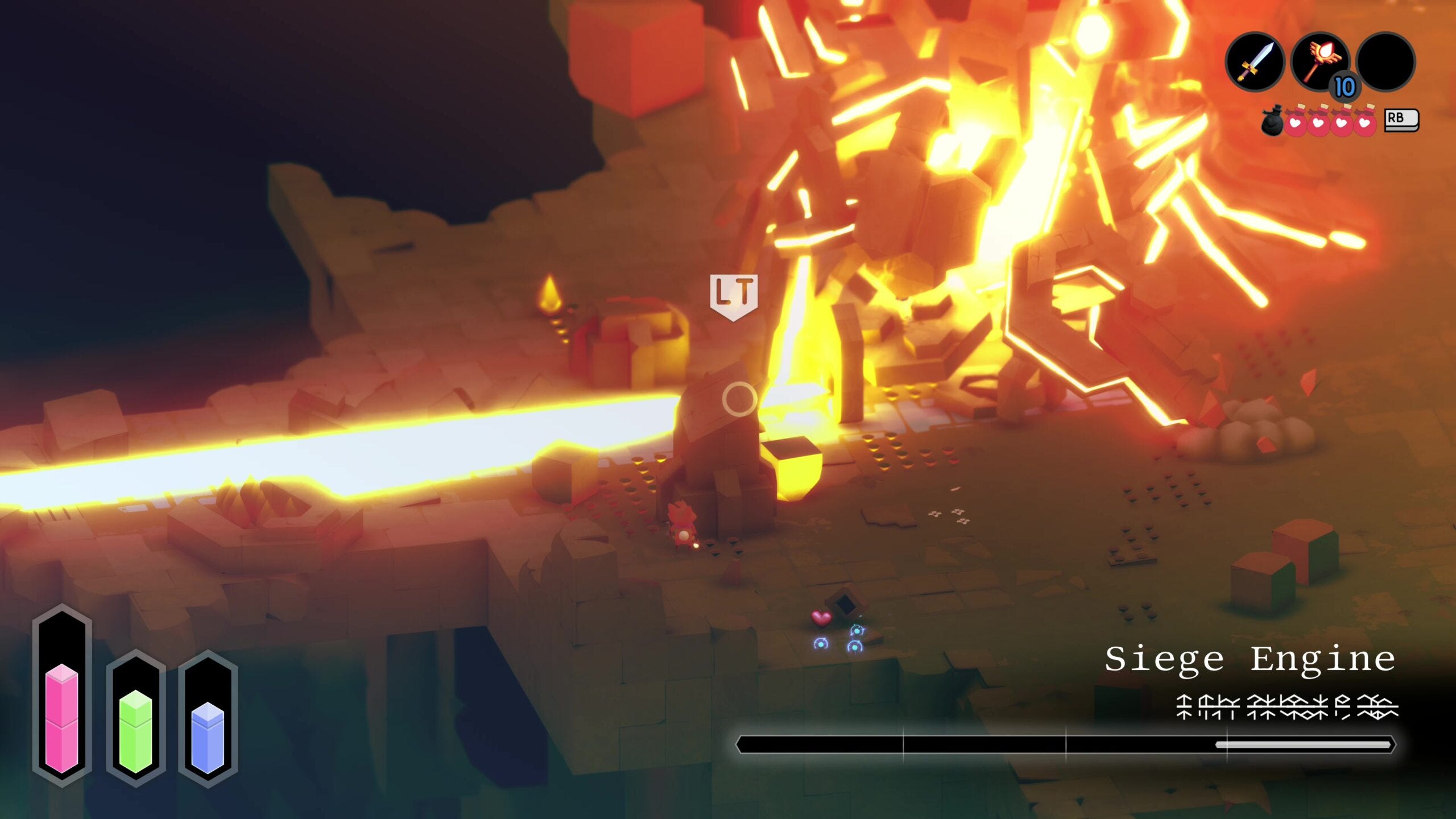
The one saving grace is that Tunic does provide you with a number of accessibility options to help, any or all of which can be toggled from the get go. When I was starting to find it tricky, I turned on the "Reduced Combat" option to have less of my health taken with each hit. When I found my stamina bar was being used up too much from blocking or dodging, I turned on the "Infinite Stamina" option to remove that obstacle. Finally, when I was just overwhelmed and only wanted to explore, the part I enjoyed the most, I hit the nuclear option and turned on "No Fail Mode", becoming invincible. These options are the only way I was able to complete the game at all (or even get past the third boss). To some this might seem like chickening out, but to me it removed a significant barrier to my enjoyment of the game, letting me focus on what I did like; discovery and exploration. The downside to this is that all challenge is then removed, resulting in a see-saw effect; either play at a punishing difficulty, or no difficulty at all, no in-between state. It might have been better to introduce more of a sliding scale to difficulty, though I must admit I was happy that at least some options catered to me.
Show, Don’t Tell
It was the sense of discovery that kept me playing. Without any spoken or written words, I really enjoyed wandering the world, finding treasure chests that seem impossible to reach, and building up the story - which takes some surprising turns, without giving any spoilers away. Just like Super Metroid or Fez, I loved the fact that the game trusted me to follow what was happening, all without a single word uttered. Even exploration felt mesmerising, particularly when you realise you reach an area that joins back to where you started. All you had to do was wander around a corner and there would be the shortcut all along, hidden because the camera was pointing at the wrong angle; yet once you see it, you then can't unsee it. Sometimes the game may become a bit obtuse, yet for the most part all the clues are there, and Tunic does not belittle your intelligence.
By the end, despite the game wanting to pummel me into submission, I ended up completing a very enjoyable adventure, one that has made me ponder it long after playing. For me, that is the best kind of ending to a game, one where the mystery still wants to unravel in my head.
Have you played Tunic? Were you able to fair better at me with the difficulty? Did you discover all the secrets? Comment below to discuss further. Thanks!
Loved this! I turned on No Fail Mode at the first boss, I didn’t want the combat difficulty to ruin my enjoyment of the game! It really did bring me back to older games where you’re just left to crack on. There were so many secrets and Easter Eggs and I resonate with your comment about feeling like a genius when you solved a puzzle. My husband and I took notes with pen and paper to help us out, it was a genuine joy!
Hang on there was a no fail mode!? I missed that completely 😅😂 loved this game as well and really enjoyed reading your take on it. I still think about it a year later :)